Industrial Control Systems in Detail: Components, Control Types and Modern Automation Technology
Industrial control systems (ICS) are technologies used to monitor, regulate, and coordinate processes in manufacturing plants, production facilities, power generation, water treatment, and other industrial environments. They combine electronic hardware, software, sensors, and communication networks to keep machines and processes operating according to defined conditions.
Context
The development of industrial control systems began with mechanical regulators and manually operated equipment. As industrial production expanded, electrical relays, pneumatic controls, and electronic instruments made it possible to automate repetitive operations. Programmable logic controllers (PLCs), supervisory control and data acquisition (SCADA) systems, and distributed control systems (DCS) later expanded the ability to manage complex industrial processes.
Modern industrial control systems can coordinate individual machines, production lines, or entire facilities. Their functions range from switching a motor on and off to regulating temperature, pressure, flow, and production sequences. The specific configuration depends on the process, operating requirements, equipment, and level of automation.
Main components of industrial control systems
An industrial control system consists of several connected elements. Each component performs a particular role in collecting information, making decisions, or controlling equipment.
Sensors: Measure physical conditions such as temperature, pressure, liquid level, speed, and flow.
Controllers: Process incoming signals and determine the appropriate control response.
Actuators: Convert control signals into physical actions, such as opening a valve or moving a mechanism.
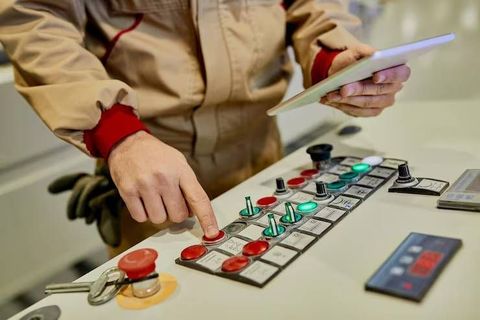
Human-machine interfaces (HMIs): Display process information and allow authorized operators to interact with equipment.
Communication networks: Transfer data between sensors, controllers, supervisory systems, and other devices.
Power and supporting equipment: Supply electrical power and help maintain the operating conditions required by the control hardware.
These components work together in a continuous process. A sensor measures a condition, the controller evaluates the measurement against a defined target, and an actuator adjusts the equipment when necessary.
How an industrial control loop works
A control loop is a basic element of industrial automation. In a temperature-control application, a sensor measures the temperature inside an industrial oven and sends the reading to a controller.
The controller compares the measured temperature with the setpoint. If the temperature is below the target, the controller may increase heating output; if it is above the target, the controller may reduce heating or activate another defined response.
The process repeats as new measurements arrive. This feedback-based operation helps maintain process conditions within an intended range, although actual performance depends on system design, sensor accuracy, equipment response, and operating conditions.
Importance
Industrial control systems matter because many industrial processes require consistent timing, coordinated equipment movement, and continuous monitoring. Without suitable controls, operators may need to perform more tasks manually, making it harder to coordinate complex sequences and identify abnormal operating conditions.
These systems are used across industries, including food processing, packaging, automotive manufacturing, chemical processing, energy production, mining, and water treatment. Their functions differ, but they commonly support process consistency, equipment coordination, production monitoring, and operational safety.
Applications across industrial sectors
In manufacturing, PLCs can coordinate conveyor belts, packaging machines, robotic equipment, and assembly stations. In process industries, control systems regulate variables such as pressure, temperature, flow, and liquid level.
Energy facilities use control systems to monitor equipment and coordinate operating sequences. Water treatment plants use them to regulate pumping, filtration stages, tank levels, and chemical dosing processes.
Industrial automation also supports data collection. Recorded measurements can help engineers investigate process interruptions, identify recurring faults, and understand changes in equipment performance.
Industrial control systems and operational safety
Control systems can support safe operation by monitoring process limits and initiating predefined responses. However, ordinary process control and safety instrumented systems have different purposes. A safety instrumented system is designed to bring a process to a defined safe state when specified hazardous conditions occur.
Safety-related functions require appropriate engineering, validation, testing, and maintenance. Their effectiveness depends on the complete design, including sensors, logic solvers, final control elements, and the procedures used to manage changes.
| System element | Primary function | Example |
|---|---|---|
| Sensor | Measures a process condition | Pressure transmitter |
| PLC | Executes programmed logic | Conveyor sequence control |
| DCS | Coordinates process control | Temperature and flow regulation |
| SCADA | Supervises geographically distributed equipment | Remote pumping stations |
| HMI | Presents process information | Operator control panel |
| Actuator | Changes physical equipment conditions | Motor drive or control valve |
| Safety instrumented system | Responds to defined hazardous conditions | Emergency process shutdown |
Recent Updates
Industrial control systems are increasingly integrating traditional automation with digital monitoring, industrial data analytics, and connected devices. Developments during 2024–2026 have continued to focus on cybersecurity, operational visibility, interoperability, and the gradual modernization of existing industrial infrastructure.
One important trend is the use of industrial edge computing. Instead of sending every measurement to a remote platform for processing, edge devices can analyze selected data near the equipment. This approach may support faster local responses and reduce unnecessary network traffic, depending on the system architecture.
Artificial intelligence and machine learning are also being explored for equipment-condition monitoring, fault detection, production analysis, and maintenance planning. These technologies can identify patterns in historical or real-time data, but their outputs depend on data quality, operating context, and appropriate verification. They do not replace every conventional control function.
Industrial connectivity and cybersecurity
Modern facilities may connect controllers, engineering workstations, supervisory platforms, and business applications. This integration can improve information sharing, but it also introduces additional communication pathways that require careful management.
The National Institute of Standards and Technology (NIST) provides guidance on operational technology security, including industrial control systems. Its guidance emphasizes understanding operational requirements, managing access, segmenting networks where appropriate, monitoring activity, and considering the potential physical consequences of cybersecurity incidents.
Industrial cybersecurity practices increasingly account for both digital and physical risks. Security changes must be planned carefully because equipment availability, timing requirements, and safety constraints can make industrial environments different from ordinary office networks.
Modernization of existing systems
Many facilities continue to operate older controllers and industrial networks because these systems remain integrated with established equipment. Modernization may involve replacing unsupported components, adding monitoring capabilities, improving network architecture, or connecting selected data sources to newer platforms.
A phased approach can help organizations evaluate compatibility and operational effects before changing critical equipment. System documentation, testing, backups, change management, and recovery planning remain important throughout modernization.
Tools and Resources
Industrial control engineers use a combination of programming environments, simulation platforms, monitoring tools, technical standards, and documentation systems to design and maintain automation equipment.
PLC programming and simulation tools
PLC engineering software is used to develop and test control logic. Depending on the platform, programs may use ladder diagrams, function block diagrams, structured text, or sequential function charts.
Simulation tools can help evaluate control sequences before they are deployed to physical equipment. Simulated results do not automatically establish that a system is safe or suitable for real-world operation, so physical testing and appropriate verification remain necessary.
SCADA and HMI platforms
SCADA software collects information from industrial equipment and presents it through operator displays, alarms, trends, and historical records. HMI platforms provide interfaces for monitoring and interacting with specific machines or processes.
Alarm management tools can help organize notifications according to process conditions and operational significance. Well-designed displays and alarm settings help operators distinguish routine changes from conditions requiring attention.
Technical standards and cybersecurity guidance
Several technical resources support industrial control system design and evaluation:
NIST Special Publication 800-82: Guidance on securing operational technology, including industrial control systems.
IEC 62443 series: Standards addressing cybersecurity for industrial automation and control systems.
IEC 61131 series: Standards relating to programmable controllers and associated programming languages.
ISO 13849 series: Standards addressing safety-related parts of machinery control systems.
These documents address different aspects of industrial technology. Their applicability depends on the equipment, system architecture, intended use, and relevant project requirements.
FAQs
What are industrial control systems used for?
Industrial control systems monitor and regulate industrial processes. They coordinate machines, control variables such as temperature and pressure, collect operational data, and support consistent equipment operation across manufacturing and process industries.
What are the main components of an industrial control system?
The main components generally include sensors, controllers, actuators, communication networks, HMIs, and supporting power equipment. Larger systems may also include supervisory software, historical data platforms, and dedicated safety-related equipment.
What is the difference between PLC, SCADA, and DCS?
A PLC executes programmed logic for machines or specific processes. SCADA supervises equipment and collects information, often across distributed locations. A DCS coordinates control functions across interconnected processes, commonly within a plant or industrial facility.
How does modern automation technology improve industrial control?
Modern automation can combine sensors, controllers, networked monitoring, and data analysis to improve process visibility and coordinate equipment. The results depend on system design, data quality, maintenance, and the suitability of the technology for the intended process.
Why is cybersecurity important for industrial control systems?
Cybersecurity helps protect industrial equipment, process information, and communication networks from unauthorized access or disruption. Because control systems can affect physical operations, security planning must consider equipment availability, operational safety, and recovery procedures as well as data protection.