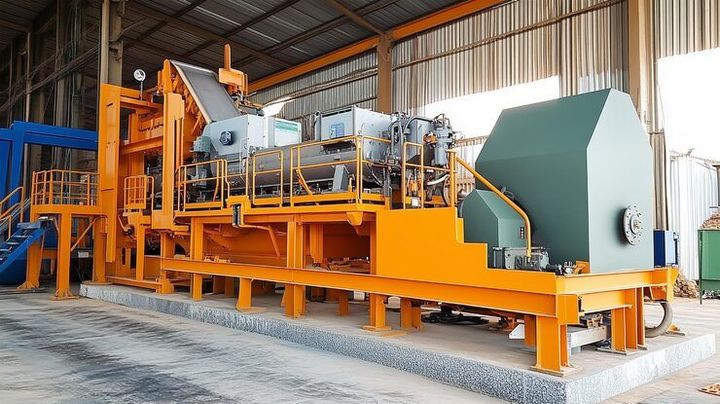
Hydroforming Machines Guide: Forming, Components, Applications and Process Considerations
Hydroforming is a metal-forming process that uses pressurized fluid to shape a workpiece against a die. Instead of relying only on a conventional mechanical punch to force metal into a desired shape, hydroforming uses controlled fluid pressure to distribute forming force across the material. This approach can produce complex shapes while maintaining a relatively continuous surface.
Context
Hydroforming is a metal-forming process that uses pressurized fluid to shape a workpiece against a die. Instead of relying only on a conventional mechanical punch to force metal into a desired shape, hydroforming uses controlled fluid pressure to distribute forming force across the material. This approach can produce complex shapes while maintaining a relatively continuous surface.
Hydroforming machines are used with several types of metal components, including tubes, sheets, and specially prepared blanks. The process developed from earlier pressure-forming methods and has become an established technique within modern metal manufacturing.
A typical hydroforming machine combines a hydraulic system, forming die, pressure equipment, sealing components, sensors, and a control system. Depending on the machine design, the workpiece may be formed inside a closed die while fluid pressure is increased in a controlled sequence.
The process is generally divided into two broad categories: tube hydroforming and sheet hydroforming. Tube hydroforming shapes a hollow tube inside a die, while sheet hydroforming uses fluid pressure to form a sheet against a tool surface.
How hydroforming works
The basic process begins with preparing a metal workpiece and placing it into a forming die. In tube hydroforming, the tube is positioned between die sections and sealed at its ends. Fluid is then introduced into the tube and pressure is increased while axial movement or other controlled forces may be applied.
The pressure causes the tube wall to expand until it contacts the internal die surface. The machine controls pressure, material movement, and forming speed to produce the intended geometry.
Sheet hydroforming follows a different arrangement. A sheet blank is positioned over or against a die, and fluid pressure pushes the sheet into the required shape. The exact arrangement depends on the machine configuration and forming method.
Main types of hydroforming
| Hydroforming type | Workpiece | Typical forming principle | Common applications |
|---|---|---|---|
| Tube hydroforming | Hollow tube | Internal fluid pressure expands the tube into a die | Frames, structural tubes, manifolds |
| Sheet hydroforming | Metal sheet | Fluid pressure forces sheet material against a die | Panels, shaped shells, formed components |
| High-pressure tube forming | Tubular blank | Higher internal pressure combined with controlled material movement | Complex tubular structures |
| Low-pressure hydroforming | Tube or sheet | Controlled pressure with relatively lower forming forces | Selected components with suitable geometries |
The suitable process depends on the material, geometry, wall thickness, required tolerances, tooling arrangement, and production requirements.
Importance
Hydroforming machines matter because many modern components require shapes that can be difficult to produce through conventional stamping, bending, or welding alone. A single formed component can sometimes incorporate several geometric features that would otherwise require multiple manufacturing steps.
The process can also reduce the number of separate joints in certain tubular structures. Fewer joints may simplify the component design and change how loads are distributed through the finished part.
Design considerations
Hydroforming is particularly relevant when a component requires curved sections, branches, varying cross-sections, or other complex geometries. However, not every shape is suitable for hydroforming.
Important considerations include:
- Material ductility and forming behavior
- Initial tube or sheet dimensions
- Wall thickness
- Required shape and dimensional tolerances
- Maximum forming pressure
- Die geometry
- Lubrication conditions
- Sealing arrangement
- Material movement during forming
- Expected production volume
The relationship between these factors affects whether the material can reach the required shape without excessive thinning, wrinkling, tearing, buckling, or other forming defects.
Components of a hydroforming machine
A hydroforming machine contains several interconnected systems. The hydraulic power unit generates and controls the pressure needed for forming. Pressure intensifiers or pumps may be used when a particular process requires higher pressure levels.
The forming die determines the external geometry of the finished component. Dies may contain complex cavities, ports, channels, and features that correspond to the intended part shape.
Sealing components prevent fluid from escaping during pressurization. In tube hydroforming, end seals are particularly important because pressure must be maintained inside the tube.
Sensors measure variables such as pressure, position, force, temperature, or displacement. A control system uses these measurements to regulate the forming sequence.
Process variables
Hydroforming relies on controlled interaction between several variables. Internal pressure is one of the most important, but it is not the only factor determining the final shape.
Material feed, axial movement, pressure increase rate, lubrication, and die movement can influence how metal flows during forming. An unsuitable combination can lead to local thinning, wrinkles, cracks, or incomplete forming.
For this reason, hydroforming process development often uses computer simulation before physical production trials. Simulation can help evaluate material flow and identify areas that may require changes to the die or forming sequence.
Recent Updates
Recent hydroforming research has focused on improving process control, simulation accuracy, material utilization, and the ability to produce complex geometries. Research published in recent years has examined tube and sheet hydroforming together with parameter studies, forming-path design, temperature control, lubrication, and intermediate material treatment.
Another continuing trend is the integration of digital modeling with forming-process development. Simulation tools can help engineers study pressure paths, material flow, deformation, and possible defect locations before extensive physical trials are performed.
Automation and process monitoring
Modern forming equipment increasingly uses sensors and computerized controls to monitor process variables. Pressure, force, displacement, and other measurements can be recorded during a forming cycle.
This data can help identify differences between production cycles and support process analysis. Automated controls can also coordinate pressure changes with die movement or material feeding where the machine configuration permits.
Complex and lightweight structures
Research continues to examine hydroforming for lightweight structures and geometrically complex components. A 2024 review described ongoing work in tube and sheet hydroforming, including approaches intended to improve formability and control thickness distribution.
Material selection remains important because different metals respond differently to hydraulic pressure and deformation. Process parameters therefore need to be considered together with material characteristics rather than treated as universal settings.
Laws or Policies
Hydroforming machines involve hydraulic pressure, moving tooling, electrical controls, and mechanical forces, so machine safety is an important part of their design and operation. Requirements can vary according to the machinery, workplace environment, intended use, and applicable regulatory framework.
International technical standards provide structured guidance for identifying hazards and reducing risks associated with machinery. ISO 16092-3 addresses safety requirements for hydraulic presses used for cold metal and materials partly made from cold metal. The standard covers hazards associated with the machine throughout relevant stages of its life cycle.
Safety considerations can include guarding around hazardous areas, control-system functions, hydraulic protection, emergency stopping arrangements, maintenance procedures, and measures that reduce the possibility of unintended machine movement.
Hydroforming equipment can also fall within broader requirements for machinery, pressure-related systems, electrical equipment, workplace safety, and environmental controls depending on the installation and application. The exact requirements should be determined from the applicable technical and regulatory framework rather than assumed from the forming process alone.
Machine documentation is another important consideration. Operating instructions, maintenance information, warnings, technical specifications, and safety procedures help users understand the intended operating conditions.
Tools and Resources
Several technical tools can support the planning and analysis of hydroforming processes.
Forming simulation software
Finite element analysis and metal-forming simulation software can model deformation, material flow, pressure paths, and potential defects. These tools are useful for studying complex shapes before physical tooling is finalized.
Pressure and force calculations
Engineering calculations can estimate relationships between forming pressure, material dimensions, tool geometry, and required forming forces. Actual machine settings depend on the specific material and process configuration.
Material data
Material databases and technical datasheets provide information such as yield strength, tensile properties, elongation, thickness ranges, and forming characteristics. These properties help engineers assess whether a material is suitable for a particular hydroforming application.
Measurement equipment
Dimensional inspection equipment can be used to evaluate formed components. Common measurement approaches include coordinate measurement systems, gauges, thickness measurement equipment, and surface inspection methods.
Technical standards
Technical standards can provide structured information about machinery safety, hydraulic systems, risk assessment, and related engineering practices. ISO 16092-3 is one example specifically addressing hydraulic press safety.
FAQs
What is a hydroforming machine?
A hydroforming machine is forming equipment that uses pressurized fluid to shape metal against a die. Depending on the machine configuration, it can form tubes, sheets, or other suitable metal blanks.
How does a hydroforming machine work?
The workpiece is positioned within or against a forming die and subjected to controlled hydraulic pressure. The pressure causes the material to deform and conform to the die while the machine controls relevant process variables.
What are the main hydroforming machine components?
Common components include a hydraulic power system, pressure-generation equipment, forming dies, sealing mechanisms, sensors, control systems, structural frames, and fluid-management equipment. The exact configuration varies according to the forming method.
What are hydroforming machines used for?
Hydroforming machines can produce tubular and sheet-metal components with complex shapes. Applications include structural tubes, manifolds, frames, panels, housings, and other formed metal components used across different manufacturing sectors.
What factors affect hydroforming results?
Material properties, wall thickness, die geometry, hydraulic pressure, lubrication, material feeding, forming speed, sealing, and the pressure path can all influence the finished component. Process simulation and controlled testing can help examine how these factors interact.
Conclusion
Hydroforming machines use controlled fluid pressure to shape metal tubes or sheets against forming dies. Their main components include hydraulic systems, dies, seals, sensors, controls, and supporting structures. Process results depend on material behavior, tooling, pressure control, lubrication, and material movement. Recent developments have increasingly focused on simulation, automation, process monitoring, and forming of complex lightweight structures, while machine safety remains an important consideration.