Vegetable Cutting Machines Explained: Types, Components, Cutting Methods and Maintenance
Vegetable cutting machines are mechanical or electrically powered systems designed to prepare vegetables by performing operations such as slicing, dicing, shredding, chopping, and cutting into specific shapes. They are used in food preparation environments where consistent cutting and repeatable processing are important.
Context
Traditional vegetable preparation relies on knives and manual techniques. As food production became more organized, mechanical cutting equipment was developed to handle larger quantities while maintaining relatively consistent dimensions. Today, vegetable cutting machines range from compact units for kitchens to larger processing equipment designed for continuous production.
The basic principle is straightforward. Vegetables are placed into a feeding area, moved toward a cutting mechanism, and processed using blades, discs, grids, or other cutting components. The machine configuration determines the cutting method, product size, processing capacity, and level of operator involvement.
Different vegetables require different approaches. Leafy vegetables may need shredding or slicing, while potatoes, carrots, onions, and other firm vegetables can be processed through dicing, julienne cutting, or other methods.
Common machine configurations
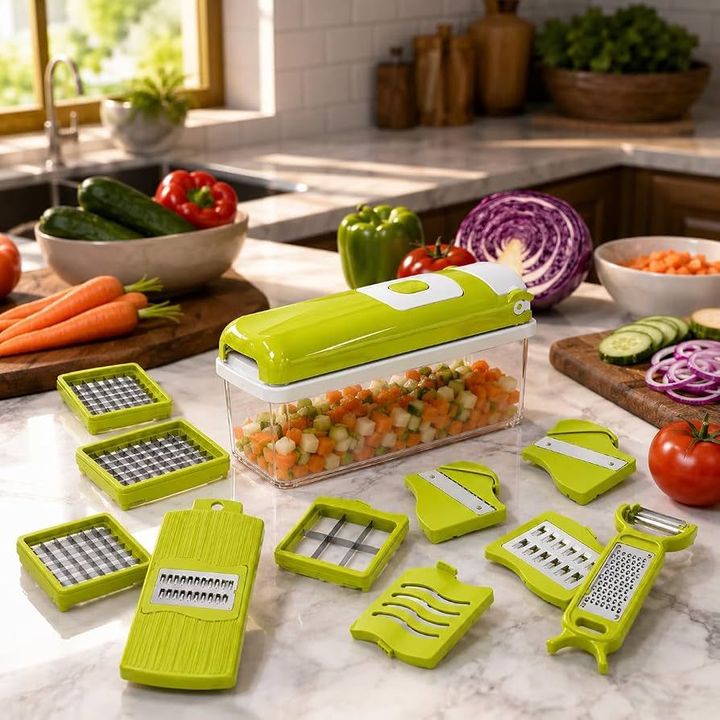
Vegetable cutting machines can be broadly grouped according to their operating method and intended application. Some use rotating blades or discs, while others use fixed blade assemblies combined with controlled product movement.
Common configurations include:
- Vegetable slicers for producing slices of relatively consistent thickness
- Dicing machines for creating cubes or rectangular pieces
- Chopping machines for smaller irregular or controlled cuts
- Shredding machines for thin strips or shredded vegetables
- Julienne cutters for narrow, elongated pieces
- Multi-function machines that accommodate several cutting attachments
The appropriate configuration depends on the vegetable type, required shape, production volume, and desired degree of uniformity.
Importance
Vegetable cutting is an important stage in food preparation because the size and shape of ingredients can affect cooking time, appearance, texture, portioning, and subsequent processing. In restaurants, institutional kitchens, food processors, and other preparation environments, repeated manual cutting can also require considerable operator involvement.
A vegetable cutting machine can standardize repetitive cutting tasks and create more consistent pieces. Consistency is particularly relevant when vegetables are later cooked, packaged, mixed, frozen, dehydrated, or incorporated into prepared foods.
Why cutting consistency matters
Uniform pieces tend to expose similar surface areas during cooking or processing. When pieces vary considerably in size, smaller pieces may become ready sooner than larger ones.
Cutting consistency can also influence:
- Cooking and heating behavior
- Product appearance
- Portion preparation
- Mixing and blending
- Packaging arrangements
- Further food processing
- Material handling
However, machine processing does not automatically produce identical results in every situation. Vegetable condition, blade sharpness, feeding method, machine settings, and product characteristics can all influence the final cut.
Factors affecting machine selection
The selection of a vegetable cutting machine depends on several practical factors. A machine intended for occasional preparation has different requirements from equipment used for continuous food processing.
| Factor | What to consider |
|---|---|
| Vegetable type | Firm, soft, leafy, fibrous, or irregular vegetables |
| Cutting method | Slicing, dicing, chopping, shredding, or julienne |
| Piece dimensions | Required thickness, width, or cube size |
| Processing volume | Quantity processed during a given period |
| Feeding method | Manual, semi-automatic, or continuous feeding |
| Blade system | Blade, disc, grid, or specialized cutting assembly |
| Cleaning | Access to food-contact components and removable parts |
| Safety | Guards, interlocks, emergency controls, and safe operating procedures |
Understanding these factors helps explain why one machine design may not be appropriate for every vegetable or application.
Recent Updates
From 2024 through 2026, vegetable processing equipment has continued to develop around automation, hygiene, energy management, operator safety, and production monitoring. The general direction has been toward equipment that integrates more easily into organized food-processing workflows.
Automation can include controlled feeding, programmable cutting cycles, sensor-based monitoring, and interfaces that allow operators to adjust processing parameters. More advanced systems can also be integrated with other preparation or packaging equipment.
Increased focus on hygiene
Food-processing equipment is increasingly designed with sanitation considerations in mind. Smooth surfaces, accessible food-contact areas, removable components, and designs that reduce difficult-to-clean spaces can simplify routine cleaning procedures.
Materials used in food-contact areas also receive attention because equipment must be appropriate for the intended food-processing environment. The exact material requirements depend on the machine design and applicable regulations.
Greater emphasis on operator safety
Modern equipment commonly incorporates physical guards, interlocking mechanisms, emergency stopping controls, and instructions intended to reduce exposure to moving cutting components.
Safety design is particularly important because vegetable cutting machines contain sharp blades and moving mechanisms. Operators need to follow the manufacturer's instructions and established workplace procedures rather than attempting to access cutting components while the machine is operating.
Digital monitoring
Some industrial food-processing systems now incorporate digital controls and monitoring features. These may track operating conditions, production settings, alarms, or maintenance information.
Digital controls can simplify parameter adjustment, but they do not eliminate the need for routine inspection. Mechanical components such as blades, bearings, belts, shafts, and fasteners still require appropriate attention.
Laws or Policies
Vegetable cutting machines used in commercial or industrial food preparation are affected by regulations covering machinery safety, food hygiene, electrical safety, worker protection, and food-contact materials. Specific requirements vary by jurisdiction and machine application.
Food-processing equipment generally needs to be designed and operated in a manner that supports hygienic handling of food. Surfaces that contact food should be appropriate for the intended application and capable of being cleaned according to the applicable procedures.
Machinery safety considerations
Regulatory frameworks commonly address hazards associated with moving machinery, electrical components, sharp cutting mechanisms, and unexpected machine operation.
Important safety features may include:
- Guards around hazardous moving components
- Emergency stopping mechanisms
- Electrical protection
- Interlocking systems where appropriate
- Clear operating instructions
- Safe cleaning and maintenance procedures
- Appropriate warnings and labels
Businesses operating food-processing equipment are generally responsible for following the workplace, machinery, and food-safety requirements applicable to their location.
Food-contact requirements
Food-contact materials may be subject to additional requirements concerning composition, contamination, cleaning, and intended use. Equipment used with raw vegetables should also be cleaned and maintained according to appropriate food-hygiene procedures.
Because regulations vary internationally, technical documentation and the applicable regulatory authority should be consulted when compliance is being assessed.
Tools and Resources
Several resources can help operators and equipment managers understand vegetable cutting machines and maintain consistent processing.
Equipment manuals
The machine manual is an important technical reference. It normally explains operating procedures, compatible cutting components, adjustment methods, cleaning instructions, safety precautions, and maintenance intervals.
Using the manufacturer's documentation is particularly important when replacing blades or changing cutting configurations.
Maintenance checklists
A written maintenance checklist can help organize routine inspections. A basic checklist may include:
- Blade condition
- Fasteners and connections
- Guards and safety mechanisms
- Belts, chains, or drive components
- Electrical connections
- Food-contact surfaces
- Lubrication requirements where applicable
- Unusual vibration or noise
- Cleaning after processing
The inspection frequency depends on machine design, operating conditions, and manufacturer instructions.
Cutting-size references
Production teams may use measurement guides to specify slice thickness, dice dimensions, or other cutting requirements. Such references help operators understand whether the selected blade assembly and machine settings correspond to the intended result.
Cleaning documentation
A cleaning schedule can record when food-contact components were cleaned, inspected, and returned to operation. Documentation can be particularly useful in environments where multiple operators work with the same equipment.
FAQs
What is a vegetable cutting machine?
A vegetable cutting machine is equipment designed to mechanically process vegetables into specific shapes or sizes. Depending on the configuration, it can perform slicing, dicing, chopping, shredding, or julienne cutting.
What are the main types of vegetable cutting machines?
Common types include vegetable slicers, dicing machines, choppers, shredders, julienne cutters, and multi-function cutting machines. The cutting mechanism and attachment determine the type of processing that can be performed.
How does a vegetable cutting machine work?
Vegetables are introduced through a feeding area and directed toward a cutting mechanism. Rotating blades, cutting discs, grids, or specialized assemblies then divide the vegetables according to the machine's configuration and settings.
How do you maintain a vegetable cutting machine?
Routine maintenance generally includes cleaning, inspection of blades and guards, checking fasteners and drive components, and following the maintenance intervals specified by the manufacturer. Power should be isolated before maintenance activities involving hazardous moving or cutting components.
What factors affect vegetable cutting machine performance?
Vegetable type, size, firmness, moisture, blade condition, feeding method, cutting configuration, and machine settings can all affect the resulting pieces. Consistent operation also depends on appropriate cleaning and maintenance.
Conclusion
Vegetable cutting machines mechanize repetitive preparation tasks such as slicing, dicing, chopping, shredding, and julienne cutting. Their performance depends on the machine configuration, cutting mechanism, vegetable characteristics, operating conditions, and maintenance practices. Recent equipment developments have placed greater attention on automation, hygiene, operator safety, and digital monitoring. Understanding these factors provides a foundation for evaluating how vegetable cutting equipment fits into different food-preparation and processing environments.