Industrial Ventilation System Explained: Types, Components, Airflow Control and Applications
An industrial ventilation system is an engineered arrangement used to move air through a workplace, remove unwanted airborne contaminants, introduce outside air, and control conditions such as heat, humidity, fumes, dust, and odors. Industrial ventilation can range from simple exhaust fans to complex systems containing hoods, ductwork, filters, dampers, fans, sensors, and control equipment. Understanding the types, components, airflow control methods, and applications.
Ventilation has been used in industrial environments for many years as an engineering method for controlling air movement. Modern systems are designed around the specific process, building layout, contaminants, required airflow, and operating conditions rather than relying on air movement alone.
Understanding Industrial Ventilation Systems
What an industrial ventilation system does
An industrial ventilation system controls the movement and replacement of air within a workplace. Depending on the design, it can bring outside air into a building, remove contaminated air, or perform both functions.
Industrial ventilation is commonly divided into general ventilation and local exhaust ventilation. General ventilation moves air throughout a larger area, while local exhaust ventilation captures contaminants close to where they are generated.
The basic objective is to control airborne conditions before they spread through the workplace. The system may also help manage temperature, humidity, odors, smoke, dust, fumes, or vapors.
Main types of industrial ventilation
Different industrial processes require different ventilation arrangements. Common types include:
- General or dilution ventilation, which introduces and distributes air throughout a work area.
- Local exhaust ventilation, which captures contaminants close to their source.
- Supply ventilation, which introduces outdoor or conditioned air into a building.
- Exhaust ventilation, which removes air from a particular area.
- Balanced ventilation, which combines controlled supply and exhaust airflow.
- Natural ventilation, which uses openings and natural pressure differences to move air.
- Mechanical ventilation, which uses fans and other equipment to control airflow.
Local exhaust ventilation is particularly useful where dust, fumes, vapors, or gases are generated at a specific location. General ventilation may be used when contaminants are distributed over a wider area or when overall air movement is needed.
Typical industrial applications
Ventilation systems are used across many industrial settings. Applications can include manufacturing plants, workshops, warehouses, laboratories, food-processing areas, chemical processing facilities, metalworking operations, painting areas, and enclosed production spaces.
The design depends on the process. A welding area may require source capture for fumes, while a large warehouse may require broader air circulation and exhaust arrangements.
Why Industrial Ventilation Matters
Air quality and airflow can affect workers, equipment, production areas, and the surrounding environment. Poorly controlled airflow can allow heat, dust, fumes, vapors, or other airborne materials to accumulate.
Ventilation is therefore an important engineering control in workplaces where airborne contaminants are generated. Regulatory guidance also recognizes ventilation as one method for controlling occupational exposure to airborne hazards.
Controlling airborne contaminants
Industrial processes can produce different types of airborne contaminants. These may include:
- Dust and fine particles
- Welding fumes
- Chemical vapors
- Mists
- Smoke
- Gases
- Heat and moisture
- Odors
The appropriate ventilation method depends on the characteristics of the contaminant and how it is generated. A hood positioned close to a source can capture contaminants before they move into the general breathing area.
Supporting workplace conditions
Ventilation also influences temperature and humidity. Manufacturing processes can generate significant heat, while some processes release moisture into the air.
Air movement can help manage these conditions when the system is properly designed. However, ventilation alone may not provide complete temperature or humidity control, so other building systems may also be required.
Protecting equipment and processes
Airborne particles and excessive moisture can affect machinery, electrical equipment, materials, and production areas. Appropriate ventilation can help control environmental conditions around sensitive processes.
The exact requirements vary according to the equipment and materials involved. Ventilation design therefore needs to consider both workplace conditions and process requirements.
Industrial Ventilation System Components
An industrial ventilation system consists of several interconnected components. Each part contributes to moving, capturing, filtering, or controlling air.
Hoods and air inlets
A hood is used in local exhaust ventilation to capture airborne contaminants near their source. Hood design and placement influence how effectively contaminants enter the exhaust stream.
Air inlets perform the opposite function by introducing air into a space. Their location affects airflow patterns and can influence whether clean air reaches occupied areas.
Ductwork
Ducts provide pathways for moving air between hoods, fans, filters, and discharge points. Their diameter, shape, length, fittings, and internal resistance influence airflow and pressure requirements.
Poorly planned ductwork can create excessive pressure losses or uneven airflow. For this reason, duct design is an important part of ventilation engineering.
Fans and air movers
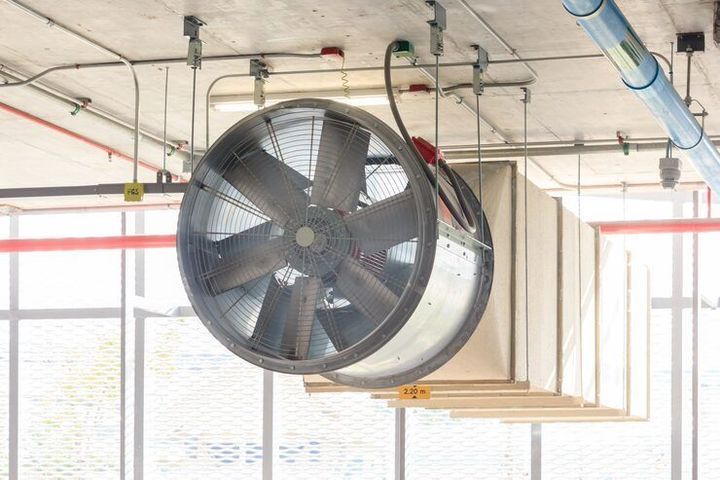
Fans provide the pressure needed to move air through ducts and other components. Different fan arrangements are selected according to airflow requirements, pressure conditions, temperature, and the characteristics of the air being moved.
The fan does not work independently. Its performance needs to match the resistance created by the ductwork, filters, hoods, dampers, and other components.
Filters and air-cleaning equipment
Some systems include filters, dust collectors, separators, or other air-cleaning equipment. These components can remove specified particles or contaminants from an air stream.
Selection depends on the contaminant, particle characteristics, required efficiency, airflow, pressure drop, and operating environment.
Dampers and control devices
Dampers regulate airflow through sections of a ventilation system. They can be used for balancing, isolation, adjustment, or control.
Modern systems may combine dampers with sensors and electronic controls. This allows airflow to respond to changing operating conditions rather than remaining at one fixed level.
Airflow Control in Industrial Ventilation
Airflow control determines how much air moves through a system and where that air travels. Correct airflow is important because excessive or insufficient movement can affect system performance.
Airflow measurement
Airflow can be measured using instruments that determine air velocity, volume flow, or pressure. Measurements may be taken at ducts, hoods, supply points, or exhaust locations.
Static pressure is another important measurement. Changes in pressure can indicate alterations in system resistance, such as blocked filters, damaged ducts, or other restrictions.
Variable airflow control
Some modern ventilation systems use variable-speed drives or electronically controlled fans. Instead of operating continuously at one fixed speed, the fan can adjust according to demand.
Sensors may monitor variables such as pressure, temperature, particulate levels, occupancy, or other process conditions. The control system can then adjust airflow within the designed operating range.
Air balancing
Air balancing involves adjusting different parts of a ventilation system so that the required airflow reaches the intended locations.
For example, several local exhaust hoods connected to one system may require different airflow levels. Balancing helps prevent one branch from receiving substantially more or less airflow than intended.
Industrial Ventilation System Applications
Industrial ventilation is used in many processes because different workplaces generate different air-quality challenges.
| Application | Common concern | Typical ventilation approach |
|---|---|---|
| Welding | Smoke and fumes | Local exhaust capture |
| Metalworking | Dust, mist, and heat | Source capture and general exhaust |
| Painting | Vapors and overspray | Enclosed exhaust and controlled airflow |
| Food processing | Heat, moisture, and odors | Supply and exhaust ventilation |
| Chemical processing | Vapors and gases | Local exhaust and controlled discharge |
| Warehousing | Heat and general air movement | General mechanical ventilation |
| Laboratories | Chemical vapors | Local exhaust systems |
| Battery-related processes | Process emissions | Source capture and dedicated exhaust |
The table provides general examples rather than universal design requirements. Actual airflow rates and equipment selection depend on the process, contaminant characteristics, building configuration, and applicable regulations.
Manufacturing facilities
Manufacturing environments often combine several ventilation approaches. Local exhaust may capture contaminants at individual machines, while general ventilation manages overall room conditions.
Large production facilities may also use automated airflow controls to respond to changes in production activity.
Laboratories and enclosed work areas
Laboratories can require carefully controlled airflow because certain activities may generate vapors, aerosols, or other airborne materials. Local exhaust equipment can capture contaminants close to the point of generation.
Enclosed work areas may also require controlled pressure relationships between adjacent spaces.
Recent Developments in Industrial Ventilation
Between 2024 and 2026, industrial ventilation has continued moving toward more measurable, automated, and energy-conscious operation. One notable direction is greater use of sensors, variable-speed fans, digital monitoring, and building-management controls.
Smarter airflow monitoring
Sensors can provide information about pressure, temperature, particulate conditions, occupancy, or other operating variables. Connected monitoring systems can help operators identify changes in airflow performance and maintenance requirements.
This trend reflects a broader movement toward condition-based building and equipment management. Instead of relying only on periodic manual checks, facilities can increasingly use operating data to understand system behavior.
Energy-conscious operation
Ventilation can require substantial fan power, particularly in large facilities with long duct runs or high airflow requirements. Variable-speed control and demand-based operation can reduce unnecessary airflow when process conditions permit.
Energy performance must still be balanced with the required airflow for contaminant control. Reducing airflow below the level required for a process can create an exposure or safety problem.
Greater focus on indoor air quality
Workplace air quality remains an important consideration. Guidance from occupational safety authorities continues to identify ventilation as an engineering method for controlling workplace airborne contaminants.
Modern projects therefore increasingly consider ventilation alongside filtration, monitoring, building controls, and process-specific containment.
Laws and Policies Affecting Industrial Ventilation
Industrial ventilation requirements depend on the country, industry, workplace activity, and substances involved. There is no single worldwide regulation covering every industrial ventilation system.
Workplace safety requirements
In the United States, for example, the Occupational Safety and Health Administration addresses ventilation through standards covering general industry, maritime activities, and construction. Its regulations include provisions relating to ventilation and airborne contaminants.
Construction rules also address local exhaust ventilation and require appropriate airflow controls when ventilation is used to control dusts, fumes, vapors, or gases.
Other countries use their own occupational safety frameworks, exposure limits, building requirements, and environmental regulations. Industrial facilities therefore need to identify the rules applicable to their location and process.
Confined spaces and hazardous atmospheres
Confined spaces can create additional ventilation requirements. For example, U.S. construction regulations require continuous forced-air ventilation in specified permit-required confined-space situations when certain conditions apply.
Ventilation should not be treated as a substitute for atmospheric monitoring or other required safety controls. The appropriate approach depends on the hazard and applicable regulations.
Tools and Resources for Industrial Ventilation
Several resources can help with ventilation planning, evaluation, and maintenance.
Airflow calculators
Airflow calculators can convert between common flow units and help with preliminary calculations. They can also be used to examine relationships between air volume, room size, and air changes.
Such calculations should not replace engineering design where hazardous contaminants or regulated exposure limits are involved.
Pressure and airflow instruments
Anemometers, manometers, differential-pressure instruments, and other measurement equipment can be used to evaluate airflow conditions. These tools help identify changes from expected operating conditions.
Ventilation design references
Occupational safety agencies, engineering organizations, building authorities, and industrial hygiene resources provide technical references on ventilation principles, exposure control, and workplace air quality.
For regulated applications, the relevant local authority and applicable engineering standards should take precedence over general online calculators or simplified guides.
FAQs
What is an industrial ventilation system?
An industrial ventilation system is an engineered arrangement that moves air through a workplace to introduce clean air, remove contaminated air, or control environmental conditions such as heat, humidity, dust, fumes, and vapors.
What are the main types of industrial ventilation?
The main types include general or dilution ventilation, local exhaust ventilation, supply ventilation, exhaust ventilation, balanced ventilation, natural ventilation, and mechanical ventilation.
How does local exhaust ventilation work?
Local exhaust ventilation captures airborne contaminants near their source before they spread through the surrounding work area. A typical arrangement can include a hood, ductwork, air-cleaning equipment, fan, and discharge point.
What components are used in an industrial ventilation system?
Common components include hoods, air inlets, ducts, fans, filters or dust collectors, dampers, sensors, controls, and discharge points. The exact combination depends on the application.
How is airflow controlled in an industrial ventilation system?
Airflow can be controlled through fan speed, dampers, pressure controls, sensors, and automated building controls. Measurements of airflow and pressure can help verify whether the system is operating within its intended range.
Conclusion
An industrial ventilation system controls air movement to manage contaminants and workplace environmental conditions. Its main elements can include hoods, ducts, fans, filters, dampers, sensors, and control equipment, with the arrangement depending on the application. Recent developments have increased the use of automated monitoring, variable airflow, and data-based controls, while workplace regulations continue to address ventilation and airborne exposure. Proper ventilation design depends on the process, building, contaminants, airflow requirements, and applicable regulations.