Understand Battery Manufacturing System: From Raw Material to Finished Cell
A battery manufacturing system is a sequence of processes that transforms raw materials into electrodes, assembles those electrodes into cells, and prepares the finished cells for use in battery modules and packs. Although battery designs vary, rechargeable lithium-ion batteries commonly involve active materials, conductive additives, binders, current collectors, separators, electrolytes, and protective casings.
Context
The manufacturing process begins with material preparation and continues through electrode production, cell assembly, electrolyte filling, sealing, formation, aging, and testing. Each stage has a specific purpose because the structure and condition of the materials can affect the electrical and physical characteristics of the finished cell.
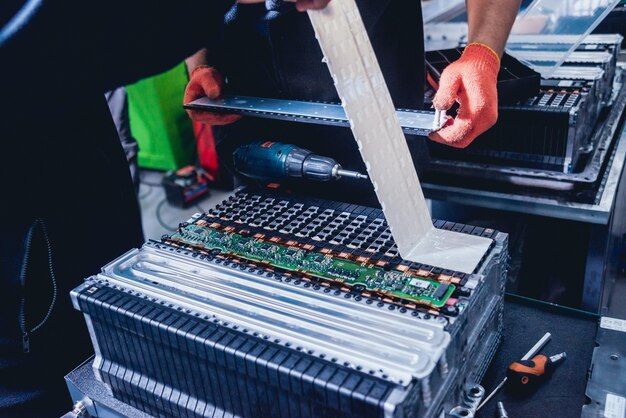
The term battery manufacturing system can describe much more than a single machine. It includes material-handling equipment, mixing systems, coating machines, drying systems, calendering equipment, slitting machines, assembly equipment, welding systems, dry-room infrastructure, formation equipment, inspection systems, and data-control platforms.
From materials to a cell
A simplified battery cell manufacturing sequence can be viewed as:
- Raw material preparation
- Electrode material mixing
- Electrode coating
- Drying
- Calendering
- Slitting and cutting
- Electrode and separator assembly
- Cell enclosure
- Electrolyte filling
- Sealing
- Formation and aging
- Electrical and physical inspection
The exact sequence varies according to cell chemistry and cell format. Cylindrical, prismatic, and pouch cells use different mechanical arrangements even though several fundamental electrode-production stages are similar.
Where textile machinery fits
Textile machinery is not normally part of the core production line for conventional lithium-ion cells. However, specialized battery designs can use woven or textile-based materials as substrates, reinforcement layers, current-collection structures, or separator-related materials.
This creates a connection with equipment such as looms, weaving looms, air jet looms, rapier looms, and Jacquard looms. These machines produce controlled textile structures rather than conventional battery electrodes.
Waterjet equipment can also appear in specialized manufacturing environments for precision cutting of suitable materials or components. Its application depends heavily on the material and process because conventional electrode production generally relies on dedicated slitting, punching, and cutting equipment rather than treating waterjet cutting as a standard cell-production step.
Importance
Battery manufacturing matters because rechargeable cells are used across transportation, portable electronics, energy storage, industrial equipment, and other electrical applications. The manufacturing system determines how raw materials are converted into consistent cells with defined electrical and physical characteristics.
A battery cell is a complex combination of materials. Small variations in coating thickness, moisture, particle distribution, alignment, drying, or assembly can influence cell performance and manufacturing consistency.
Why process control matters
Battery factories therefore use controlled environments and inspection systems throughout production. Important considerations include:
- Material composition and particle distribution
- Electrode coating thickness
- Drying conditions
- Electrode density
- Separator positioning
- Welding quality
- Electrolyte quantity
- Moisture control
- Cell dimensions
- Electrical characteristics
Dry-room conditions are particularly important during several lithium-ion manufacturing stages because some battery materials and electrolytes are sensitive to moisture. Production facilities may therefore use specialized air-treatment systems to maintain controlled humidity.
Main battery manufacturing stages
| Manufacturing stage | Main purpose | Typical equipment |
|---|---|---|
| Material preparation | Prepare active and supporting materials | Mixers, material-handling systems |
| Electrode mixing | Combine active material with other ingredients | Vacuum or planetary mixers |
| Coating | Apply electrode slurry to current collector | Coating and drying systems |
| Calendering | Control electrode thickness and density | Calender rolls |
| Slitting | Divide coated material into required widths | Slitting machines |
| Assembly | Combine electrodes and separator | Stacking or winding equipment |
| Electrolyte filling | Introduce electrolyte into cell | Filling and vacuum systems |
| Sealing | Close the cell enclosure | Sealing and welding equipment |
| Formation | Establish the initial electrochemical condition | Formation chargers |
| Testing | Examine electrical and physical characteristics | Inspection and testing systems |
Cell formats
Three common cell formats are cylindrical, prismatic, and pouch. Cylindrical cells use a rolled electrode structure inside a rigid cylindrical enclosure. Prismatic cells generally use a rectangular enclosure, while pouch cells use flexible packaging material.
The chosen format affects the assembly equipment, enclosure process, thermal management arrangement, and testing requirements.
Recent Updates
Battery manufacturing has been changing through greater automation, process monitoring, material optimization, and digital production control. Manufacturers are increasingly connecting equipment data with quality systems so that production conditions can be monitored across multiple stages.
Another major trend is the diversification of battery chemistry. Lithium iron phosphate, nickel-containing chemistries, sodium-ion systems, solid-state concepts, and other technologies are being developed for different applications. These chemistries can require different materials and manufacturing processes.
Automation and digital monitoring
Automated inspection is becoming more significant as production systems become more integrated. Cameras, sensors, electrical testing equipment, machine-vision systems, and process-control software can monitor dimensions, surface conditions, alignment, and other manufacturing parameters.
Data systems can also connect individual process stages. For example, information from coating, calendering, slitting, assembly, and formation can be associated with particular production batches or cells.
Alternative material structures
Research into advanced separators, solid electrolytes, flexible electrodes, and textile-based battery components is creating additional connections between battery manufacturing and textile technologies.
In specialized applications, woven structures can be produced using different loom configurations. Air jet looms use controlled air streams to insert the weft, while rapier looms use a mechanical rapier system. Jacquard looms provide more detailed control of individual warp yarns, allowing complex woven patterns.
These technologies belong primarily to technical-textile manufacturing rather than mainstream lithium-ion cell assembly. Their relevance arises when a battery design incorporates a woven or textile-based component.
Waterjet cutting can similarly have a role in certain specialized material-processing operations. It can produce complex shapes without using a conventional mechanical cutting blade, although its suitability depends on the material, required tolerance, contamination considerations, and downstream process requirements.
Manufacturing sustainability
Battery manufacturing is also receiving greater attention regarding material recovery, carbon-footprint reporting, recycling, and traceability. The European Union's Batteries Regulation establishes requirements covering areas such as carbon-footprint information, recycled materials, performance, due diligence, and battery information.
The European Commission published updated guidance in 2026 for preparation of the Digital Batteries Passport. For relevant electric-vehicle, light-transport, and industrial batteries above the specified capacity threshold, the battery passport requirement is scheduled to apply from February 2027.
Laws or Policies
Battery manufacturing is influenced by product-safety, environmental, chemical, transportation, workplace, and waste-management requirements. The exact rules depend on the jurisdiction, battery category, chemistry, intended application, and whether the battery is manufactured domestically or placed on another market.
International technical standards are also used to evaluate battery performance, safety, and manufacturing-related characteristics. Manufacturers may need documented procedures covering material traceability, production controls, testing, quality management, and waste handling.
The European Union's Batteries Regulation is one example of a comprehensive regulatory framework. It covers batteries throughout parts of their lifecycle, including production, information requirements, collection, recycling, and material recovery. The regulation also establishes requirements for certain rechargeable industrial and electric-vehicle batteries concerning electrochemical performance and durability.
Regulatory requirements are also evolving. In 2025, EU institutions adopted an amendment postponing application of certain battery due-diligence obligations by two years, moving their application to August 2027.
These requirements demonstrate that a modern battery manufacturing system involves more than physical production. Documentation, traceability, environmental information, and lifecycle management are increasingly connected with manufacturing activities.
Tools and Resources
Several categories of tools help explain, plan, or monitor battery manufacturing systems.
Process-flow diagrams
A manufacturing process-flow diagram can map the movement of materials from receiving through electrode production, cell assembly, formation, inspection, and final integration. Such diagrams are useful for understanding where individual machines fit within a production line.
Battery testing equipment
Electrical testing systems can measure parameters such as voltage, current response, capacity-related characteristics, and other performance indicators. Formation equipment also records electrical information during the controlled initial cycling of cells.
Material and production databases
Digital manufacturing databases can associate raw-material batches with electrode batches and finished cells. This type of traceability can help identify where a process variation occurred.
Textile production equipment
Where a battery design uses textile-based components, specialized textile equipment may become relevant. Weaving looms can create woven structures, while air jet looms, rapier looms, and Jacquard looms provide different methods of controlling textile construction.
These machines should not be treated as interchangeable battery-production machines. Their role depends on the specific material architecture being manufactured.
Cutting and inspection systems
Waterjet systems, laser systems, mechanical cutters, machine vision, dimensional measurement tools, and other inspection technologies can be used for selected material-processing tasks. The appropriate equipment depends on the material, geometry, tolerance, contamination requirements, and production sequence.
FAQs
What is a battery manufacturing system?
A battery manufacturing system is the collection of processes and equipment used to transform raw materials into finished battery cells. It generally includes material preparation, electrode production, cell assembly, electrolyte filling, sealing, formation, and testing.
What machines are used in battery cell manufacturing?
Common equipment includes mixers, coating machines, drying systems, calendering machines, slitting systems, stacking or winding equipment, welding systems, electrolyte filling equipment, sealing equipment, formation systems, and inspection equipment.
Are weaving looms and air jet looms used in battery manufacturing?
Weaving looms, air jet looms, rapier looms, and Jacquard looms are not standard equipment for conventional lithium-ion cell production. They can become relevant when specialized battery designs use woven or textile-based materials.
Is waterjet cutting part of battery manufacturing?
Waterjet cutting is not normally a core step in conventional lithium-ion electrode production. It may be used for selected material-processing or component-manufacturing applications when the material and required geometry make the process appropriate.
What happens after battery cells are assembled?
After assembly and electrolyte filling, cells are sealed and undergo formation. They can then go through aging, electrical testing, inspection, grading, and further assembly into modules or battery packs, depending on the application.
Conclusion
A battery manufacturing system connects raw-material preparation, electrode production, cell assembly, formation, and testing into a controlled production sequence. Digital monitoring, automation, material traceability, recycling considerations, and alternative battery chemistries are influencing how these systems are developed. Textile technologies such as weaving looms, air jet looms, rapier looms, and Jacquard looms have specialized relevance where woven battery materials are involved, while waterjet systems can be used for selected material-processing applications. The specific equipment and sequence ultimately depend on battery chemistry, cell format, material structure, and production requirements.