Torque Motor Insights: Working Methods, Motor Types, Performance and Industrial Applications
A torque motor is an electric motor designed to produce rotational force, known as torque, directly at the shaft or rotating assembly. Unlike conventional motor arrangements that often use a separate gearbox to increase output torque or reduce rotational speed, a torque motor can generate substantial torque at relatively low rotational speeds.
Context
Torque motors are commonly associated with permanent-magnet synchronous motor technology, although the broader category includes different motor constructions and operating principles. They are used in equipment where controlled rotary movement, low-speed operation, positioning accuracy, and compact mechanical arrangements are important.
The basic principle is similar to other electric motors. Electrical energy creates a magnetic field that interacts with another magnetic field, producing rotational force. The motor's construction, winding arrangement, magnetic materials, control system, and operating conditions determine how that force is generated and controlled.
How torque is produced
Motor torque results from electromagnetic interaction between the stator and rotor. The stator is the stationary part containing electrical windings, while the rotor is the rotating part positioned inside or around the stator depending on the motor design.
When electrical current flows through the stator windings, a rotating magnetic field can be created. The rotor responds to this field, producing rotation. In a permanent-magnet torque motor, magnets on the rotor contribute a magnetic field that interacts with the stator field.
A motor controller can regulate current, position, and speed. This allows the motor to produce a controlled amount of torque according to the requirements of the connected machine.
Torque motor versus conventional motor systems
A conventional motor may operate through a gearbox, belt, pulley, or other transmission arrangement. These components can change speed and torque characteristics but also add mechanical elements between the motor and driven equipment.
A direct-drive torque motor places the motor's output more directly at the driven axis. This arrangement can reduce the number of mechanical transmission components and can influence system size, mechanical response, maintenance requirements, and positioning behavior.
| Characteristic | Torque motor | Conventional motor with transmission |
|---|---|---|
| Typical operating range | Low to moderate speed | Often moderate to high speed |
| Torque generation | Direct at driven axis | Often modified through transmission |
| Gearbox requirement | May not be required | May be used |
| Mechanical components | Relatively few in direct-drive designs | More transmission components may be present |
| Position control | Suitable for controlled rotary axes | Depends on motor and transmission |
| Typical applications | Rotary tables, winding systems, indexing equipment | Pumps, fans, conveyors and general machinery |
Importance
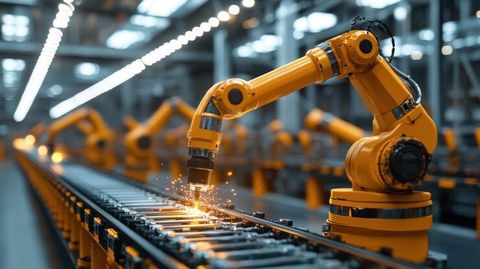
Torque motors matter because many industrial machines require controlled rotation without relying heavily on mechanical transmission components. Applications can include rotary tables, machine tools, robotics, semiconductor equipment, winding machinery, printing equipment, and other automated systems.
A direct-drive arrangement can provide a short mechanical path between the motor and the load. This can reduce the effects associated with gears, couplings, backlash, and mechanical transmission elements, depending on the system design.
Torque motors can also be useful where a machine must repeatedly accelerate, decelerate, stop, reverse, or hold a rotary position. The motor and controller can be configured for the required torque, speed, and motion profile.
Factors that affect performance
Torque motor performance depends on several interacting factors. Electrical current affects electromagnetic torque, while motor construction influences torque density, speed range, heat generation, and efficiency.
Important factors include:
Continuous torque, which describes the torque the motor can produce during sustained operation under specified conditions.
Peak torque, which describes a higher torque level that may be available for a limited operating period.
Speed range, which defines the rotational speeds at which the motor can operate within its specified limits.
Torque ripple, which refers to periodic variations in produced torque that can influence motion smoothness.
Thermal performance, which determines how effectively heat generated during operation can be managed.
Position feedback, which provides information needed by a controller for accurate motion regulation.
The required performance depends heavily on the application. A rotary table may prioritize positioning and smooth low-speed movement, while a winding machine may place greater emphasis on torque regulation and controlled tension.
Torque density and thermal considerations
Torque density describes the amount of torque generated relative to the motor's physical size or mass. A high torque density can be useful where installation space is limited, but it does not remove the need for thermal management.
Electrical resistance in the windings generates heat during operation. Bearings, magnetic materials, insulation, cooling arrangements, and surrounding machine components can also influence operating temperature.
Some industrial torque motors use air cooling, while others use liquid cooling or other thermal-management arrangements. The appropriate method depends on the motor design and operating conditions.
Recent Updates
From 2024 through 2026, developments in torque motor technology have generally followed broader trends in industrial automation, direct-drive motion systems, energy efficiency, and digital control.
Motor manufacturers and automation engineers have increasingly focused on higher torque density, improved thermal management, compact mechanical integration, and more precise feedback systems. These developments are particularly relevant to machines that require repeated motion with controlled acceleration and positioning.
Advances in motor control
Modern motor controllers can use sophisticated feedback and control algorithms to regulate current, torque, velocity, and position. High-resolution encoders and other feedback devices can provide detailed information about rotor position.
Digital control also allows motion parameters to be coordinated with other machine functions. This can be important in automated production systems where multiple axes must operate together.
Integration with industrial automation
Torque motors are increasingly associated with direct-drive automation architectures. Eliminating a gearbox can simplify the mechanical connection between a motor and a rotary load, although the overall system still requires appropriate bearings, feedback equipment, structural support, and control electronics.
The growing use of robotics, automated machine tools, precision positioning systems, and electrically controlled production equipment continues to create applications for direct-drive motor technology.
Efficiency and system design
Energy efficiency remains an important consideration in industrial motor design. Improving magnetic circuits, winding arrangements, cooling systems, and electronic control can influence overall electrical and mechanical performance.
However, motor efficiency should be considered together with the complete machine. A direct-drive motor may change the energy characteristics of the overall system differently from a motor combined with a gearbox, depending on load profile and operating conditions.
Laws or Policies
Torque motors are industrial electrical components, so their design, installation, and use can be affected by electrical safety requirements, machinery regulations, electromagnetic compatibility requirements, and energy-efficiency frameworks.
The specific requirements vary according to the country, application, motor rating, installation environment, and whether the motor is incorporated into a larger machine. Manufacturers and system integrators generally need to consider applicable standards for electrical insulation, protection, electromagnetic compatibility, machine safety, and documentation.
International standards can provide technical frameworks for evaluating rotating electrical machines. IEC 60034, for example, is a major series covering rotating electrical machines and includes requirements related to ratings, performance, testing, thermal behavior, and other characteristics.
Machinery incorporating torque motors may also fall under additional requirements because the complete machine can present mechanical, electrical, thermal, or control-related hazards. The applicable requirements therefore depend on the complete installation rather than the motor alone.
For regulatory decisions, the relevant national authority and the current edition of applicable technical standards should be checked because requirements can change.
Tools and Resources
Several technical resources can help engineers, students, and equipment designers understand torque motor selection and operation.
Torque and speed calculations
Basic motor calculations can help relate torque, speed, and mechanical power. Mechanical output power can be expressed using torque and angular speed:
P = T × ω
where P represents mechanical power in watts, T represents torque in newton-metres, and ω represents angular speed in radians per second.
For rotational speed expressed in revolutions per minute, the relationship can also be written approximately as:
P = (T × n) / 9.55
where n represents rotational speed in revolutions per minute.
These equations describe the relationship between mechanical torque and power. Actual motor operation also depends on electrical input, losses, temperature, controller behavior, and other system factors.
Motor selection data
Motor datasheets normally contain information such as:
Continuous and peak torque
Rated and maximum speed
Voltage and current
Winding resistance
Torque constant
Back-electromotive-force characteristics
Rotor inertia
Thermal limits
Encoder or feedback compatibility
Mounting dimensions
Comparing these parameters with the machine's load profile helps determine whether a particular motor architecture is technically suitable.
Simulation and engineering software
Motor simulation tools can model electromagnetic behavior, thermal characteristics, mechanical loads, and control responses. Computer-aided engineering platforms can also help evaluate how a torque motor interacts with the machine structure and connected load.
Motor-control development environments are used to configure current loops, speed control, position control, and feedback systems. The exact tools depend on the motor controller and application.
FAQs
What is a torque motor?
A torque motor is an electric motor designed to produce substantial rotational force, particularly at relatively low speeds. Direct-drive versions can connect the motor more directly to the driven axis without requiring a conventional gearbox.
How does a torque motor work?
A torque motor works through electromagnetic interaction between the stator and rotor. Electrical current creates a magnetic field in the stator, and interaction between the stator field and rotor field produces rotational torque.
What are the main torque motor types?
Torque motor designs can include permanent-magnet synchronous motors, induction-based designs, and other specialized direct-drive motor arrangements. Permanent-magnet synchronous designs are widely associated with high-torque, low-speed direct-drive applications.
Where are torque motors used?
Torque motors can be used in rotary tables, machine tools, robotics, winding equipment, printing systems, indexing mechanisms, semiconductor equipment, and other industrial automation applications where controlled rotary motion is required.
What affects torque motor performance?
Torque motor performance is affected by current, winding design, magnetic materials, rotor construction, cooling, speed, load characteristics, controller settings, and feedback resolution. Thermal limits are also important because excessive heat can affect motor operation and component life.