Servo Motor Overview: Types, Working Principles, Components and Industrial Applications
A servo motor is an electromechanical device designed to control the position, speed, or movement of a mechanical system. Unlike a motor that operates mainly at a set speed, a servo motor typically works with a control system that compares the required movement with the actual movement and adjusts its operation accordingly.
Context
Servo motors are used in industrial automation, packaging machinery, robotics, CNC machines, printing equipment, and automated assembly systems. They help machinery perform controlled movements, such as rotating a shaft to a particular angle, moving a cutting head along a defined path, or positioning a product during packaging.
The term servo refers to a control arrangement rather than one specific motor design. A complete servo system commonly includes a motor, a drive, a feedback device, and a controller. These components work together to achieve the movement specified by the machine's control program.
How a servo motor developed
Early servo mechanisms were developed to control the movement of mechanical systems using feedback. As electrical motors, electronic controllers, and position sensors advanced, servo technology became increasingly useful in applications requiring repeatable movement and coordinated operation.
Modern servo systems may use alternating-current (AC) motors, direct-current (DC) motors, brushless designs, and different feedback technologies. Their configuration depends on the required torque, speed, precision, operating environment, and type of motion.
Main components of a servo motor system
A servo motor system contains several parts that perform different functions.
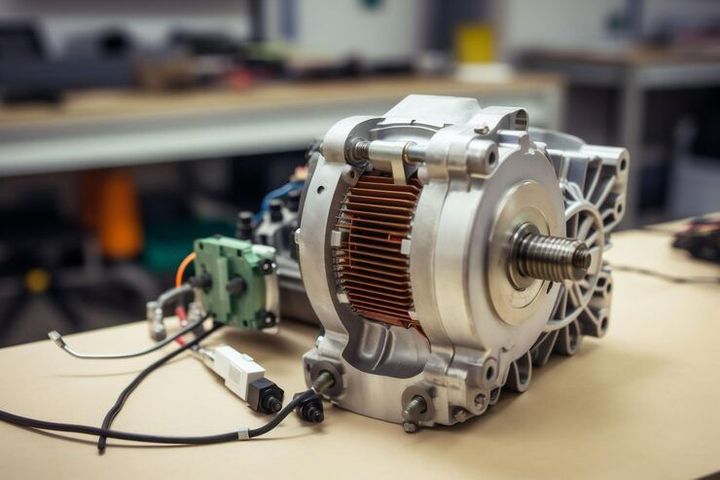
Motor: Converts electrical energy into rotational or linear mechanical movement.
Servo drive: Regulates the electrical power supplied to the motor according to control commands.
Controller: Generates motion commands and coordinates the required movement.
Encoder or feedback sensor: Measures position and, in suitable configurations, provides information used to determine speed.
Shaft or mechanical coupling: Transfers rotational movement to the connected equipment.
Power supply: Provides the electrical energy required by the drive and associated components.
Some systems also include a brake, gearbox, temperature sensor, or separate position sensor. These additions depend on the application and mechanical design.
Importance
Servo motors are important in industrial environments because many machines need more than simple rotation. They may have to move materials by a precise distance, maintain a controlled speed, synchronize multiple axes, or stop at a defined position during a production sequence.
For example, a packaging machine may need to advance film by a specific length before cutting it. A robotic arm may need to position a component before assembly, while a CNC machine may move a cutting tool along programmed coordinates. Servo systems help coordinate these movements with the machine's operating sequence.
Problems addressed by servo control
A servo system can adjust motor operation when the actual movement differs from the commanded movement. This feedback-based arrangement supports controlled motion under changing operating conditions, although its performance depends on system design, tuning, mechanical loading, and sensor accuracy.
Servo technology is particularly relevant in applications that require:
Repeatable positioning of tools, components, or products.
Controlled acceleration and deceleration.
Coordinated movement across multiple machine axes.
Changes in speed during a production cycle.
Monitoring of movement through feedback signals.
Servo motors are not necessary for every industrial application. A basic fan or pump, for instance, may operate adequately with a conventional motor or a variable-frequency drive. The additional control capabilities of a servo system are useful when the machine's movement requirements justify its complexity.
Servo motors and conventional motors
Conventional motors are often used when continuous rotation is the main requirement. A servo motor system is designed to control motion according to specific commands, commonly using feedback to compare actual performance with the target.
| Feature | Servo motor system | Conventional motor system |
|---|---|---|
| Main purpose | Controlled position, speed, or motion | Continuous or general-purpose rotation |
| Feedback | Commonly uses a feedback device | May operate without position feedback |
| Position control | Suitable for commanded positioning | Usually requires additional control equipment |
| Speed adjustment | Controlled through the servo drive | Depends on motor type and control arrangement |
| Typical applications | Robotics, CNC axes, packaging machinery | Fans, pumps, conveyors, and general machinery |
The distinction is not absolute. Conventional motors can also operate with feedback and advanced controllers. The appropriate arrangement depends on the machine's performance requirements.
Recent Updates
Recent developments in servo technology have focused on compact drive electronics, improved motion-control integration, industrial networking, and more efficient motor designs. Manufacturers increasingly integrate servo drives with programmable logic controllers (PLCs), motion controllers, and industrial communication networks to coordinate multiple machines and axes.
Integrated drives and industrial communication
Some modern servo systems combine the motor and drive into a compact assembly. This arrangement can reduce separate cabinet components and simplify installation in suitable applications, although it may introduce different requirements for cooling, access, and maintenance.
Industrial Ethernet and other real-time communication technologies also allow controllers to exchange motion commands and feedback information with servo drives. The actual communication protocol depends on the equipment and automation architecture.
Energy efficiency and monitoring
Servo drives can adjust motor output to match changing movement demands. In applications with frequent acceleration and deceleration, some systems can return braking energy to a shared DC bus or the electrical supply through regenerative equipment. Whether this improves overall energy use depends on the operating cycle and system configuration.
Condition monitoring is another area of development. Drive data, temperature readings, vibration measurements, and fault records can help maintenance teams identify operating changes. These functions do not eliminate mechanical wear or guarantee that failures will be detected before they occur.
Software-based motion control
Modern automation systems increasingly use software to configure motion profiles, coordinate multiple axes, and diagnose drive faults. Simulation and commissioning tools can help engineers evaluate machine movement before or during installation.
However, software capabilities vary across platforms. Compatibility, control-loop performance, cybersecurity, and the requirements of the complete machine remain important considerations when integrating servo equipment.
Laws or Policies
Servo motors are generally subject to rules that apply to electrical equipment, industrial machinery, electromagnetic compatibility, and workplace safety. Requirements vary by jurisdiction, voltage category, intended use, installation environment, and whether the equipment is incorporated into a larger machine.
Electrical safety standards address risks such as electric shock, insulation failure, overheating, and unintended electrical hazards. Machinery safety standards address hazards created by moving parts, unexpected startup, access to dangerous areas, and failures in control systems.
International standards may be used to assess motor performance, drive safety, electromagnetic compatibility, and machinery control functions. Relevant examples include IEC 60034 for rotating electrical machines, IEC 61800 for adjustable-speed electrical power drive systems, and ISO 13849 for safety-related parts of machinery control systems. The applicable edition and specific requirements depend on the equipment and jurisdiction.
In India, industrial electrical equipment and machinery may be subject to applicable requirements administered by relevant authorities and standards bodies, depending on the product category and installation. The Bureau of Indian Standards publishes Indian Standards, while workplace electrical safety and machinery requirements may involve other applicable rules.
Compliance cannot be determined from the motor type alone. The complete machine, electrical installation, protective devices, control architecture, and intended operating environment may all affect the requirements.
Tools and Resources
Several technical resources help explain servo motor operation and support system planning.
Motor sizing calculators
Motor sizing tools estimate the torque, speed, inertia, and power needed for a particular movement. Inputs may include the moving mass, travel distance, acceleration time, transmission ratio, friction, and duty cycle. These calculations help establish initial requirements, but engineering verification is necessary before selecting a complete system.
Servo drive configuration software
Drive configuration software is used to set operating parameters, define motion limits, adjust control-loop settings, and review fault information. Some platforms include simulation features and diagnostic displays. Incorrect settings can cause unstable motion or equipment damage, so configuration must follow the equipment documentation and appropriate procedures.
Technical manuals and engineering standards
Motor and drive manuals provide information about wiring, installation, cooling, permissible loads, feedback devices, and maintenance. Standards catalogues from IEC, ISO, and national standards bodies help readers identify documents relevant to electrical safety and machine control.
PLC and motion-control simulators
Automation simulation platforms can model movement sequences and interactions between controllers, motors, and machine components. They are useful for understanding coordinated motion and testing control logic, although simulation results do not replace physical validation of the installed machine.
FAQs
What is a servo motor and how does it work?
A servo motor converts electrical energy into mechanical movement within a control system. The controller sends a command, the drive regulates motor operation, and a feedback device reports movement information when the system uses closed-loop control. The controller can then adjust operation to reduce the difference between the commanded and actual movement.
What are the main types of servo motors?
Common categories include AC servo motors, DC servo motors, brushless servo motors, and brushed servo motors. Servo systems may also be classified by their mechanical output, such as rotary or linear movement. The suitable type depends on torque, speed, precision, duty cycle, and environmental requirements.
What is the difference between a servo motor and a stepper motor?
A servo system commonly uses feedback to monitor actual movement, while a stepper motor often operates by moving in discrete steps without position feedback. Closed-loop stepper systems also exist, so the distinction depends on the complete control arrangement rather than the motor name alone.
Where are servo motors used in industry?
Servo motors are used in robotic arms, CNC machines, packaging systems, automated assembly equipment, printing machinery, pick-and-place systems, and material-handling equipment. They are useful where controlled positioning, speed changes, or synchronized movement is required.
What determines servo motor accuracy?
Accuracy depends on factors such as the feedback sensor, drive and controller settings, mechanical backlash, shaft coupling, load, vibration, temperature, and machine structure. Resolution, repeatability, and absolute positioning accuracy are different measures and should not be treated as interchangeable.