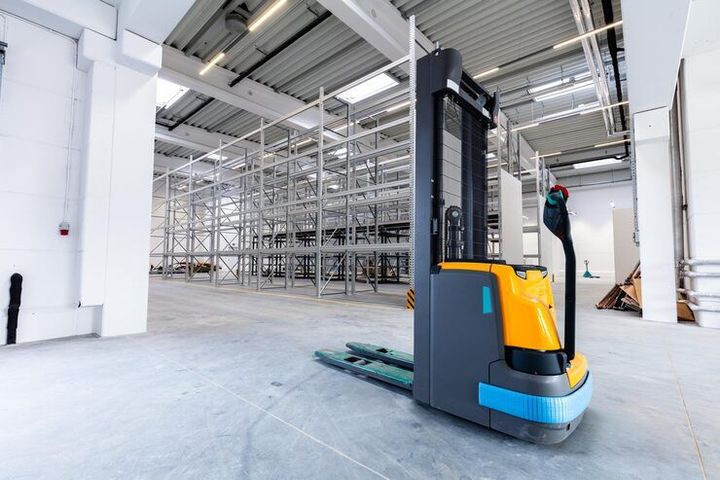
Electric Stacker Guide: Lifting Mechanisms, Battery Systems and Warehouse Applications
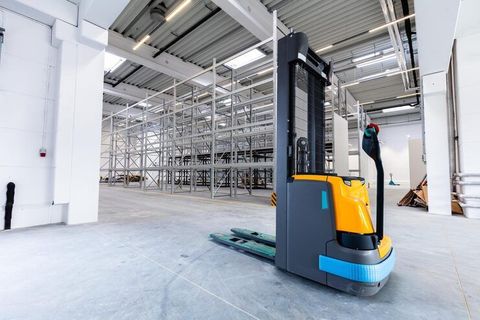
An electric stacker is a powered material-handling machine designed to lift, move, and position palletized loads within warehouses, storage areas, production facilities, and distribution environments. Unlike manually operated pallet equipment, an electric stacker uses an electric motor and battery system to assist with travel and lifting.
Context
The basic design combines several systems, including forks, a mast, lifting components, drive controls, braking equipment, and a rechargeable battery. Depending on the configuration, an operator may walk behind the machine or ride on a platform while controlling its movement.
Electric stackers developed from the broader family of pallet trucks and industrial lifting equipment. Their purpose is to handle loads vertically in locations where conventional forklifts may have more space requirements than necessary. Different designs are available for different aisle widths, lifting heights, pallet configurations, and load characteristics.
Main components of an electric stacker
An electric stacker typically contains these major components:
Forks that support the pallet or load.
Mast that guides vertical movement.
Hydraulic lifting system that raises and lowers the forks.
Electric motor that powers travel and, depending on the design, the hydraulic pump.
Battery system that supplies electrical energy.
Steering and control handle or operator controls.
Load backrest or related protection components on applicable configurations.
Wheels and braking components that support movement and stopping.
The exact arrangement varies by machine design. Capacity, lifting height, wheel configuration, mast arrangement, and operator position can all influence how a particular electric stacker is used.
Importance
Electric stackers are relevant to warehouse operations because storage increasingly involves vertical use of available floor space. A machine that can raise pallets to different levels can support organized movement between floor locations, storage positions, production areas, and staging zones.
They are particularly useful in environments where palletized materials need to be lifted without using a larger counterbalanced forklift for every movement. However, an electric stacker still requires suitable floor conditions, adequate clearance, appropriate load handling, and trained operation.
Warehouse applications
Common applications include:
Moving pallets between storage and staging areas.
Positioning loads on low- or medium-height storage locations.
Supporting production material movement.
Handling packaged goods within warehouses.
Transferring pallets around loading and receiving areas.
Organizing inventory in relatively narrow working spaces.
The appropriate machine depends on the load, lifting height, travel distance, aisle arrangement, floor surface, and frequency of operation. A stacker intended for occasional pallet movement may have different characteristics from one used repeatedly throughout a warehouse.
Electric stacker types
Electric stackers can be grouped according to their operating configuration and lifting arrangement.
A walkie stacker is controlled by an operator walking behind or beside the machine. A ride-on stacker includes a platform or riding position, which can be relevant where longer travel distances are involved.
Straddle stackers use legs that extend around the pallet, while counterbalance designs use a different weight-distribution arrangement. Reach configurations can extend the load toward storage positions and are designed for particular rack layouts.
| Electric stacker type | General characteristic | Typical application |
|---|---|---|
| Walkie stacker | Operator walks with the machine | Short-distance pallet movement |
| Ride-on stacker | Operator rides on a platform or position | Longer internal travel |
| Straddle stacker | Legs accommodate certain pallet arrangements | Varied pallet configurations |
| Counterbalance stacker | Uses counterbalance principles | Loads where straddle legs are unsuitable |
| Reach stacker | Forks can extend toward storage positions | Selected rack and aisle layouts |
These categories can overlap because manufacturers may combine different features in one machine. The machine's rated capacity and operating instructions remain more important than the category name alone.
Lifting mechanisms
The lifting mechanism is responsible for raising and lowering the forks. In many electric stackers, an electric motor drives a hydraulic pump that creates pressure in the hydraulic circuit.
Hydraulic pressure moves a cylinder or related lifting components. The mast then guides the vertical movement of the forks. Chains, rollers, cylinders, and other mechanical components can transfer or control the lifting motion depending on the mast design.
The lifting capacity is affected by several factors, including load weight, load position, lifting height, mast configuration, and load center. A machine's rated capacity should therefore be considered together with its load chart or manufacturer specifications rather than treating capacity as a single value that applies in every operating condition.
Recent Updates
Electric stacker technology has continued to develop alongside broader changes in warehouse equipment. From 2024 through 2026, attention has increasingly focused on battery technology, energy management, ergonomic controls, compact machine designs, and integration with digitally managed warehouse operations.
Battery developments
Lithium-ion batteries have become more visible in electric material-handling equipment. Compared with traditional lead-acid systems, lithium-ion designs can provide different charging characteristics and may allow opportunity charging during suitable operational periods.
Lead-acid batteries remain relevant because they are established technologies with familiar charging and maintenance practices. Lithium-ion and lead-acid systems also have different requirements concerning charging areas, temperature, battery management, ventilation, inspection, and handling.
Battery selection should therefore consider the operating pattern rather than relying on battery type alone.
Digital controls and monitoring
Modern electric stackers may include electronic displays that show battery status, operating information, fault indicators, and other machine data. Some equipment can also connect with fleet or warehouse management systems.
These technologies can help organizations organize equipment information and monitor operating patterns. However, electronic features do not replace basic inspections, appropriate training, or attention to the physical working environment.
Ergonomic developments
Control handles, steering systems, braking controls, visibility features, and operator platforms have also evolved. Designs increasingly consider repetitive movement, control placement, visibility around the load, and maneuverability within warehouse spaces.
The practical effect depends on the machine configuration and operating environment. A compact design may be useful in a narrow area but may have different load or stability characteristics than a larger machine.
Laws or Policies
Electric stackers are generally subject to workplace safety requirements because they are powered industrial trucks or related material-handling equipment. The exact rules depend on the country, jurisdiction, workplace type, equipment classification, and operating environment.
International standards also provide technical frameworks for industrial truck safety. ISO 3691-1 addresses safety requirements and verification for several categories of self-propelled industrial trucks, including pallet-stacking trucks and battery-powered industrial trucks.
Workplace rules commonly address operator competence, equipment inspection, load handling, pedestrian separation, visibility, floor conditions, charging procedures, and maintenance. Requirements may also apply to training and evaluation before an operator works independently.
Battery technology introduces additional considerations. IEC 62485-6 covers safety requirements for lithium-ion batteries and battery installations used in traction applications, including material-handling trucks.
Because regulations differ between jurisdictions, a general article cannot establish the exact legal requirements for every workplace. Organizations using electric stackers should refer to the current workplace-safety rules and equipment documentation applicable to their location.
Operator training
Training is an important part of powered industrial truck safety. Training programs commonly cover controls, steering, braking, load capacity, stability, operating surfaces, pedestrian movement, inspections, charging, and the limitations of the particular machine.
Training requirements may also change when a different type of truck is introduced or workplace conditions change. The exact training, evaluation, documentation, and refresher requirements depend on the applicable jurisdiction and workplace rules.
Tools and Resources
Several practical resources can help with understanding and managing electric stacker operations.
Load-capacity information
The machine's identification plate, load chart, or operating manual provides information about rated capacity and operating limitations. These details should be considered before lifting a pallet because capacity can change with lifting height, load center, attachments, or configuration.
Battery monitoring tools
Battery indicators and battery-management systems can provide information about charge status and system condition. Charging records can also help organizations understand usage patterns and establish consistent battery-handling procedures.
Inspection checklists
A daily or pre-use inspection checklist can cover:
Fork condition and alignment.
Mast and lifting components.
Wheels and tires.
Steering and controls.
Braking function.
Warning devices.
Battery and electrical connections.
Hydraulic components.
Visible damage or leakage.
The checklist should correspond to the particular equipment and applicable workplace requirements.
Warehouse layout tools
Warehouse planning software, aisle-width calculators, rack-layout tools, and facility drawings can help evaluate whether an electric stacker can maneuver safely within a particular area. Important dimensions include aisle width, rack spacing, turning space, ceiling clearance, and lifting height.
Manufacturer documentation
The operating manual is an important technical reference because it provides machine-specific information about controls, rated loads, charging, inspections, lifting limitations, and operating procedures. General guidance should not replace the instructions supplied for the specific equipment.
FAQs
What is an electric stacker used for?
An electric stacker is primarily used to lift, move, and position palletized loads within warehouses and other material-handling areas. Applications can include storage, receiving, production movement, and internal pallet transfer.
How does an electric stacker lifting mechanism work?
An electric motor commonly powers a hydraulic pump, which creates pressure to operate the lifting cylinder or related mechanism. The mast guides the forks vertically, while chains, rollers, cylinders, or other components transfer the lifting movement depending on the design.
What battery is used in an electric stacker?
Electric stackers commonly use rechargeable battery systems such as lead-acid or lithium-ion batteries. The appropriate battery depends on the equipment design, operating pattern, charging arrangements, environmental conditions, and manufacturer specifications.
Are electric stackers suitable for narrow warehouse aisles?
Some electric stackers are designed for relatively confined warehouse areas, but suitability depends on the machine's dimensions, turning radius, load size, rack arrangement, and required clearance. Aisle width should be evaluated using the actual equipment dimensions rather than assuming that every stacker can operate in a narrow aisle.
What should be checked before operating an electric stacker?
A pre-use inspection can include the forks, mast, wheels, steering, brakes, controls, battery, hydraulic components, warning devices, and visible damage. The inspection should follow the equipment documentation and applicable workplace requirements.
Conclusion
An electric stacker combines an electric drive system, rechargeable battery, lifting mechanism, mast, forks, and operator controls for pallet handling and vertical movement. Different configurations support different warehouse layouts, pallet arrangements, travel patterns, and lifting requirements. Battery technology, electronic controls, ergonomic design, and digital monitoring continue to influence the development of electric material-handling equipment. Safe operation depends on suitable equipment selection, correct load handling, appropriate training, inspections, and compliance with applicable workplace requirements.